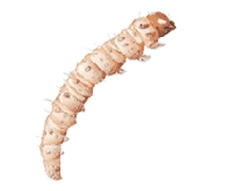
Sod Webworm.
Several species of sod webworms or “lawn moths” commonly infest home lawns. These include the silver-striped sod webworm, the bluegrass sod webworm and the larger sod webworm. Over the past few years, we have observed another sod webworm species: the burrowing sod webworm.
Latin Name
Silver-striped sod webworm (Fissicrambus mutabilis) (Clemens), Bluegrass sod webworm (Parapediasia teterrella) (Zincken), Sod webworm (Pediasia trisecta) (Walker), Burrowing sod webworm (Acrolophus popeanellus) (Clemens).
Appearance
Adult moths, when at rest, often face downward on a grass stem and wrap their wings around their abdomen. Sod webworm adults have siphoning (straw-like) mouthparts, are dull-colored moths with a wingspan of ¾ to 1 inch, and their front wings frequently are whitish or dull gray to tan-brown with longitudinal stripes and other markings. The adult is easily recognized by a pair of projections arising from the front of the head that resembles a snout. The mature larva is about ¾ inch long, brown to green with darker spots on the surface of its body, and has a long setae rising from the dark spots and mottled brown head capsule.
Habitat
On warm, balmy evenings, you may notice a group of pale-brown moths with prominent “snouts” taking flight over turfgrass. Sod webworm larvae can cause major damage to residential turfgrass, especially during periods of drought. Sod webworm larval damage often is observed in a lawn as brown patches up to the size of a baseball. In some instances, the brown patches are punctured with pencil-sized holes a result of birds searching for the webworm burrows. Feeding damage from sod webworm larvae frequently goes unnoticed during periods of drought. The most severe damage usually occurs in July and August.