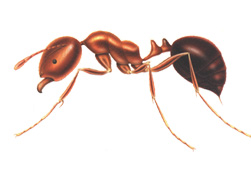
Fire Ants.
In addition to stinging humans, imported fire ants can sting pets, livestock and wildlife. Crop losses are also reported due to fire ants feeding on seedlings and even citrus trees. Running over hard fire ant mounds found in clay soils can damage harvesting machinery used on farms. Electrical equipment and utility housings may serve as fire ant nest sites, sometimes resulting in short circuits.
Latin Name
Solenopsis richteri Forel (black imported fire ant), Solenopsis invicta Buren (red imported fire ant)
Appearance
Imported fire ants are aggressive, reddish brown to black ants that are 1/8 to 1/4 in length. They construct nests, which are often visible as dome-shaped mounds of soil, sometimes as large as 3 feet across and 1.5 feet high (Plate 111). In sandy soils, mounds are flatter and less visible. Fire ants usually build mounds in sunny, open areas such as lawns, pastures, cultivated fields and meadows, but they are not restricted to these areas. Mounds or nests may be located in rotting logs, around trees and stumps, under pavement and buildings, and occasionally indoors. When their nests are disturbed, numerous fire ants will quickly run out of the mound and attack any intruder. These ants are notorious for their painful, burning sting that results in a pustule and intense itching, which may persist for 10 days. Infections may occur if pustules are broken. Some people have allergic reactions to fire ant stings that range from rashes and swelling to paralysis and anaphylactic shock. In rare instances, severe allergic reactions cause death.
Habitat
The term “imported fire ants” generally refers to two species of ants: the black imported fire ant and the red imported fire ant. Fire ants currently infest over 260 million acres in Alabama, Arkansas, Florida, Georgia, Louisiana, Mississippi, North Carolina, Oklahoma, South Carolina, Tennessee, Texas and Puerto Rico.