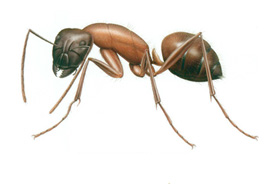
Carpenter Ants.
The Florida carpenter ant complex is comprised of several species, two of which are common around structures: Buckley and Emery. These bi-colored, arboreal ants are among the largest ants found in Florida, making them apparent as they forage or fly indoors and out.
Latin Name
Camponotus floridanus (Buckley) and Camponotus tortuganus (Emery)
Appearance
Workers vary in size, ranging from 5.5 to 11 mm in length. Smaller workers are called minors while larger workers are called majors. Winged females (alates) are the largest caste reaching up to 20 mm in length. There is no sting, but workers can bite and spray formic acid for defense. The thorax and head are ash brown to rusty-orange and the gaster is black. Body hairs are abundant, long and golden.
Habitat
During the flight season, carpenter ants can often be found in alarming numbers.
Homeowners are sometimes concerned about Florida carpenter ants damaging the structural integrity of their homes, but that simply does not happen. Some ants do damage wood: the black carpenter ant (DeGreer) Camponotus pennsylvanicus is one of them and is found in the Florida panhandle, and a few other species found in the western U.S. also damage wood. Florida carpenter ants, however, seek either existing voids in which to nest or excavate only soft materials such as rotten or pithy wood and Styrofoam. Other concerns about Florida carpenter ants are that they sting (they do not) and bite (they do).
http://www.entnemdept.ufl.edu/creatures/urban/ants/fl_carpenter_ants.htm