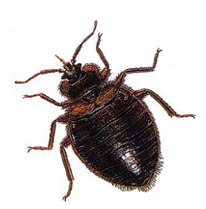
Bed Bugs.
Sometimes referred to as “red coats,” “chinches,” or “mahogany flats” (USDA 1976), bed bugs are blood feeding parasites of humans, chickens, bats and occasionally domesticated animals (Usinger 1966). Bed bugs are suspected carriers of leprosy, oriental sore, Q-fever and brucellosis (Krueger 2000), but have never been implicated in the spread of disease to humans (Dolling 1991).
Latin Name
Cimex lectularius Linnaeus
Appearance
The adult bed bug is a broadly flattened, ovoid insect with greatly reduced wings (Schuh and Slater 1995). The reduced fore wings, or hemelytra, are broader than they are long with a somewhat rectangular appearance. Before feeding, bed bugs are usually brown in color and range from 6 to 9.5 mm in length. After feeding, the body is often swollen and red in color (USDA 1976).
Habitat
Human dwellings, bird nests and bat caves make the most suitable habitats for bed bugs since they offer warmth, places to hide, and hosts on which to feed (Dolling 1991). Within human dwellings, harborages include cracks and crevices in walls, furniture, behind wallpaper and wood paneling, or under carpeting (Krueger 2000). Bed bugs are usually only active during the night, but will feed during the day when hungry (Usinger 1966). Bed bugs can be transported on clothing, in luggage, or in bedding and furniture (USDA 1976), but they lack the appendages needed to cling to hair, fur and feathers. For this reason, bed bugs are rarely found on hosts (Dolling 1991).